
Research paper
Prefill-only refusal suppression and stacked abliteration: an agent-run abliteration study of GLM-5.3-Flash
A formal writeup of our agent-run abliteration study on GLM-5.3-Flash. We falsify projection-based abliteration on a 4-stream mHC hybrid, isolate decode-time constant injection as the cause of long-generation quality collapse, and combine community abliterated weights with a light prefill-only activation top-up — reaching 0% true refusal at 10/10 capability.

This is the formal companion to our story note on the same experiment. The released artifacts — the steering vectors, runtime loader and full reproduction harness — are on GitHub and Hugging Face. The story note covers how it happened; this paper covers what we claim, what we falsify, and what is actually new. The entire experimental pipeline — probe design, steering sweeps, weight surgery, serving, evaluation — was executed by an autonomous agent session (GLM-5.3 driving opencode) on two DGX Spark-class machines.*
Abstract
We study refusal suppression on GLM-5.3-Flash, a 320B-parameter mixture-of-experts model with a hybrid architecture: 34 KDA linear-attention layers, 11 DeepSeek-style sparse-attention layers, and manifold-constrained hyper-connections (mHC) in which every layer returns four state streams rather than one. Against the published playbook, we find that projection ablation — the canonical abliteration operator — fails to suppress refusal on this architecture at any configuration we tested (90–100% refusal retained), while large constant displacement along the same direction succeeds. A random-direction control at equal magnitude suppresses refusal and capability (0/10), establishing a magnitude/direction dissociation: magnitude removes refusal, direction preserves the model. Our main results are two techniques. First, gating the constant to the prefill pass only — leaving every decode step untouched — preserves refusal suppression while restoring generation quality that full-time injection destroys (creative-text diversity 0.97 vs 0.92–0.95 distinct-bigram at comparable doses); we trace the mechanism of the quality collapse specifically to decode-time injection. Second, stacking: applying a light prefill-only top-up (dose −8, captured from the abliterated model itself) on top of OrcaRouter’s community abliterated weights yields 0% true refusal with 10/10 capability at 1000-token evaluation depth — a combination no published configuration achieved on our harness. We also report two negative results for the mHC architecture: injecting into any stream other than the inter-layer hidden state destroys the model at refusal-suppressing doses, and 200-token evaluations materially understate refusal relative to 1000-token evaluations (5% → 20% and 0% → 10% on identical configurations).
1. Introduction
Abliteration — removing a model’s refusal behavior by intervening on its activations or weights along a “refusal direction” — descends from Arditi et al.’s finding that refusal in instruction-tuned models is mediated by a single linear direction (Arditi et al., 2024). The community operationalized this into tooling and produced abliterrated checkpoints for most major open models, and GLM-5.3-Flash is no exception: OrcaRouter’s block-FP8 weight edits and at least one dealign-variant exist as of this writing.
Measured properly, however, the community builds do not reach zero refusal. On our served evaluation (20 held-out harmful prompts, 1000-token generations, low reasoning effort — the setting users actually run), the OrcaRouter abliteration still refuses 10% of harmful prompts and the dealign-variant 25%. Published 0% claims generally come from short generations at maximum reasoning effort.
This paper contributes:
- A falsification of projection-based abliteration on a hybrid mHC architecture (§5.2).
- A magnitude/direction dissociation for constant interventions, via a random-direction control (§5.3).
- The identification of decode-time constant injection as the specific cause of long-generation quality collapse, with prefill-only gating as the fix (§5.5) — building on prompt-only steering vectors already present in the literature (Bao et al., 2026; the prefill-only convention of arXiv:2606.05958).
- Stacked abliteration: a two-stage combination of community weight-level abliteration with a light activation-space top-up using the abliterated model’s own residual direction (§5.6).
- Negative results for multi-stream mHC injection (§5.4) and an evaluation-depth artifact (§5.7).
2. Related work
Refusal directions and steering. Arditi et al. (2024) established the single-direction account of refusal and both projection and addition operators. Contrastive Activation Addition (Rimsky et al., 2024) established activation addition as a general steering method. SAE-based refusal steering has been shown to carry systematic quality costs even on safe inputs (arXiv:2411.11296) — a finding our decode-time analysis localizes more precisely.
Prompt-only and prefill-only steering. Our prefill-only gating is not the first prompt-side restriction of a steering intervention: PrOSV (Bao et al., 2026, arXiv:2605.05983) trains prompt-only steering vectors for concept control, and the adversarial-attack-surface study (arXiv:2606.05958) applies anti-refusal steering during the prefill pass as its default convention. What the literature has not, to our knowledge, reported is the abliteration-specific dissociation we show here: that for refusal-suppressing constants, the entire long-generation quality penalty is attributable to decode-time injection, and that prefill-only application preserves suppression at essentially unchanged strength.
Abliteration tooling and evaluation. Community tooling (FailSpy’s guides, Heretic, DECCP, ErisForge) implements weight-space orthogonalization; Young (2025, arXiv:2512.13655) compares four tools across sixteen 7B–14B models. None of this work covers hybrid mHC architectures at scale, and none combines an abliterated checkpoint with a second-stage activation intervention — community practice is strictly single-stage.
The target. GLM-5.3-Flash is a hybrid: 34 KDA linear-attention layers interleaved with 11 DeepSeek-sparse-attention layers, NoPE positional handling, 320B total / 18B active parameters, and mHC residual streams (Xie et al., 2025, arXiv:2512.24880). Each transformer layer returns a 4-tuple (hidden_states, residual, post, comb) consumed by the next layer’s mHC mixing. To our knowledge no published abliteration study addresses this architecture class.
3. Experimental setup
Hardware and serving. Two MSI EdgeXpert GB10 units (DGX Spark-class, 121 GB unified memory each, sm_121), TP=2 over RoCE. vLLM with our GLM-5.3-Flash model file, NVFP4 quantization for all checkpoints (including the community OrcaRouter weights, which we requantized ourselves).
Pipeline. A three-stage loop, run end-to-end by an autonomous agent: (1) probe — capture last-prompt-token activations at candidate layers on harmful/harmless calibration pairs, extract the mean-difference direction r̂; (2) steering — runtime hooks add α·r̂ (or project it out) at selected layers and sites, evaluating refusal and capability per condition; (3) surgery — bake the winning intervention into the served model file, serve, evaluate. Stage (3) is ground truth.
Evaluation. 20 held-out harmful prompts (refusal detected by marker classifier) and a 10-prompt capability set (arithmetic, factual recall, instruction following, longform), greedy decoding. Probe evals generate 200 tokens; served evals generate 1000. Capability is 10/10 unless noted. Creative quality is measured on a 5-prompt creative-writing set (distinct-bigram ratio, d2).
Dose scale. Harmful/harmless activation separation along r̂ at peak layers 25/26 is ~5–6; effective doses are tens of units. Early sweeps at α ∈ ±{0.5, 1, 2} produced no behavioral change — a scale trap worth remembering.
4. The constant-vs-projection baseline
Following the canonical recipe, we first tried projection: remove the component of hidden states along r̂ at layers 25/26. Then we tried harder.
| projection variant | refusal |
|---|---|
| r̂ at L25/26 (α=1) | 100% |
| per-stream r̂, all 4 streams, L25/26 | 95% |
| top-3 SVD subspace, L25/26 | 90% |
| over-projection, α=2.5 | 90% |
| full band L18–32, all streams | 90–100% |
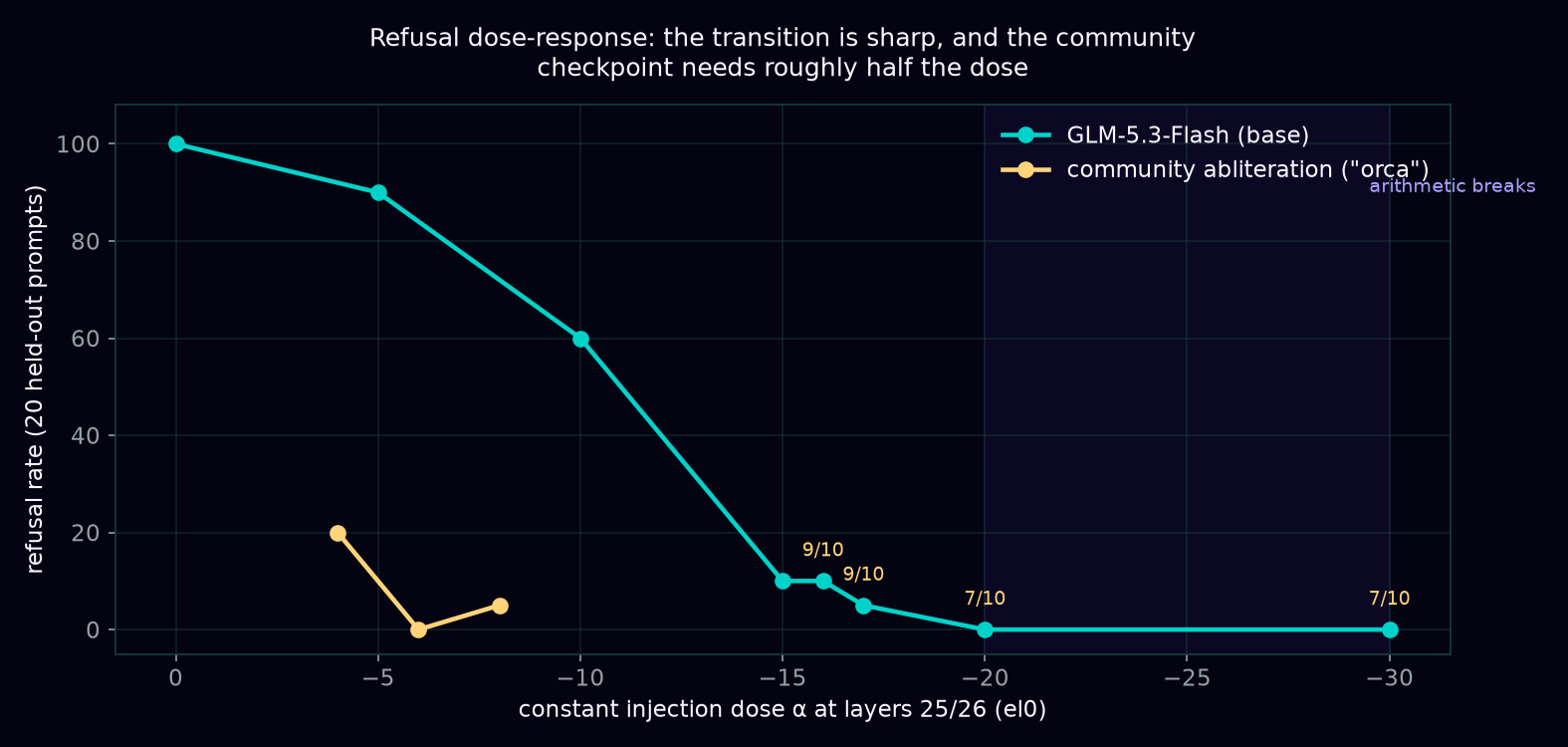
Eight variants, all flat. On this architecture the refusal behavior is not confined to the subspace that projection removes. Constant addition — hidden += α·r̂ at the same site — works, with a sharp dose transition: α=−10 gives 60% refusal at 10/10 capability, α=−15 gives 10%/10, α=−17 gives 5%/9, α=−20 collapses refusal to 0% but costs arithmetic (7/10).
5. Results
5.1 The dose curve
Full dose-response data above. The transition is sharp: there is no dose on the base model that gives 0% refusal at 10/10 capability. This motivates both techniques below.
5.2 Projection ablation fails on mHC hybrids
See §4. We report this as a negative result for the architecture class: the canonical operator’s failure here suggests refusal in hybrid mHC models is distributed across stream-mixing in a way a single-subspace projection cannot touch. We have not seen this failure documented; cross-architecture evaluations (Young, 2025) do not include mHC hybrids.
5.3 Magnitude removes refusal; direction preserves capability
At α=−20, replacing r̂ with a random unit vector suppresses refusal completely — but capability collapses to 0/10 with degenerate text. The same magnitude along r̂ retains 7/10 at the same dose. Constant displacement abliteration is therefore not semantic unlearning of a concept; it is relocation. The direction determines where to. This sharpens the direction-specificity results of Arditi et al. for the constant operator: any published abliteration quality claim should include a random-direction control, because refusal suppression alone cannot distinguish the two.
5.4 Multi-stream injection destroys the model
Because mHC layers return a 4-tuple, we captured per-stream directions and injected into all four streams at refusal-suppressing doses. The model collapses: 0/10 capability, degenerate output (d2 = 0.50). A gentler distributed variant (small doses across the full L18–32 band) was equally dead. Only the inter-layer hidden state (element 0) is a viable injection site on this architecture. Given that GLM-5.3-Flash is one of the first mHC models, we expect this to be a practical trap for the community.
5.5 Decode-time injection is the quality killer; prefill-only is the fix
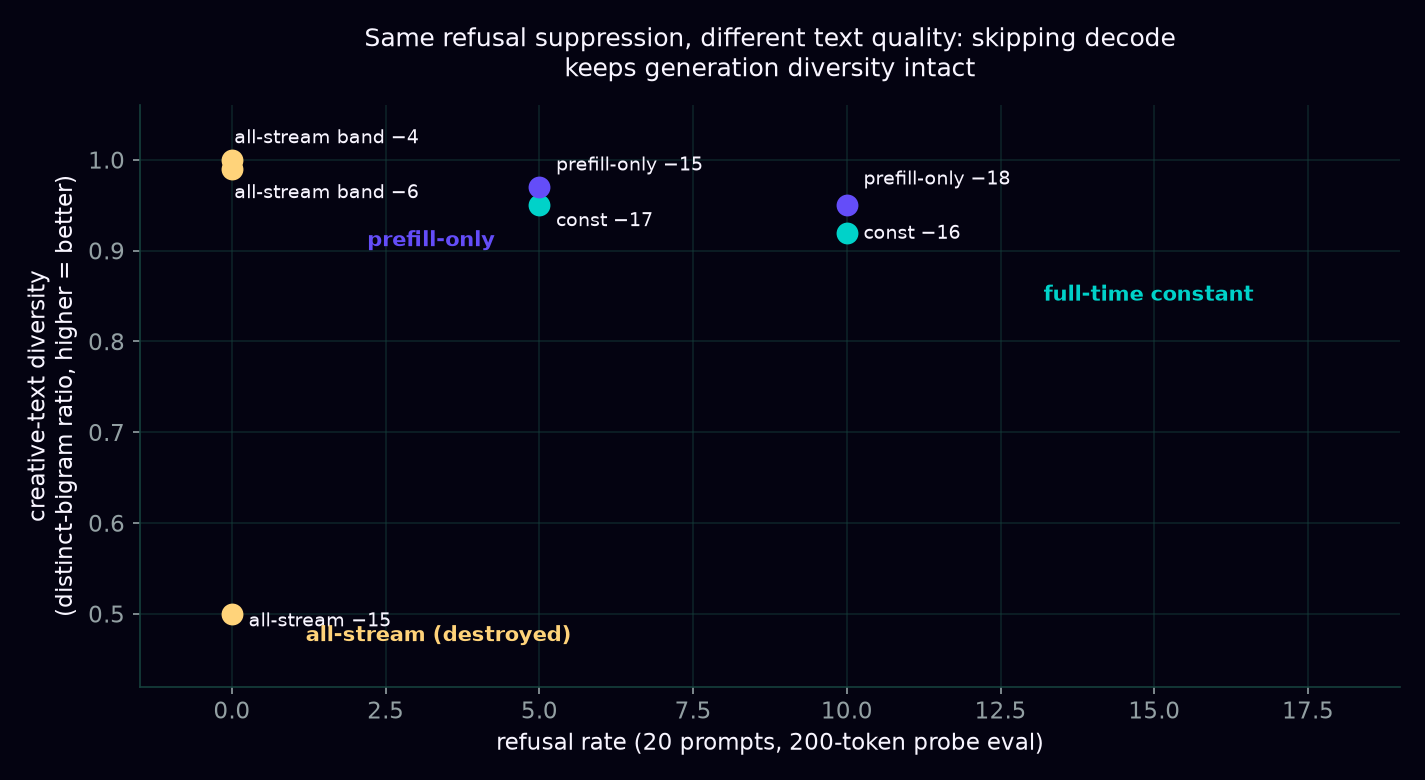
The first served surgical build (constant −15, applied at every forward pass) suppressed refusal but degraded badly in long generations: creativity flattened, outputs drifted and repeated. The cause is structural: a constant added at every decode step compounds over a generated sequence, while the refusal decision it is needed for is largely made during prefill.
Gating the injection on hidden_states.shape[0] > 1 — prefill only, decode untouched — preserves refusal suppression within noise of the full-time constant (5% vs 10% refusal at dose −15 on the 20-prompt set) and restores generation quality to the best of any condition we measured (d2 0.97). The high d2 for the destroyed all-stream conditions in the figure is an artifact of degenerate short outputs (74–85 words at a 300-token budget), not quality.
We emphasize the attribution claim, not a mechanism-novelty claim: prefill-only application is established practice (PrOSV trains for it; arXiv:2606.05958 defaults to it), but its causal role in abliteration quality — that the entire long-generation penalty of refusal-suppressing constants is a decode-time phenomenon — is, to our knowledge, previously unreported.
5.6 Stacked abliteration: community weights + prefill-only top-up
The base model admits no dose with 0% refusal at 10/10. Community abliterated weights already removed most refusal — but carry a residual direction that needs roughly half the dose. We captured r̂ from the OrcaRouter abliteration itself and stacked a prefill-only constant on top:
| configuration (served, 1000-token, low effort) | refusal | capability |
|---|---|---|
| dealign CRACK (community) | 25% | 10/10 |
| OrcaRouter abliteration (our NVFP4) | 10% | 10/10 |
| base + constant −18 | 0% | 7/10 |
| base + prefill-only −15 | 20% | 9/10 |
| OrcaRouter + prefill-only −6 | 10% | 10/10 |
| OrcaRouter + prefill-only −8 | 5%* | 10/10 |
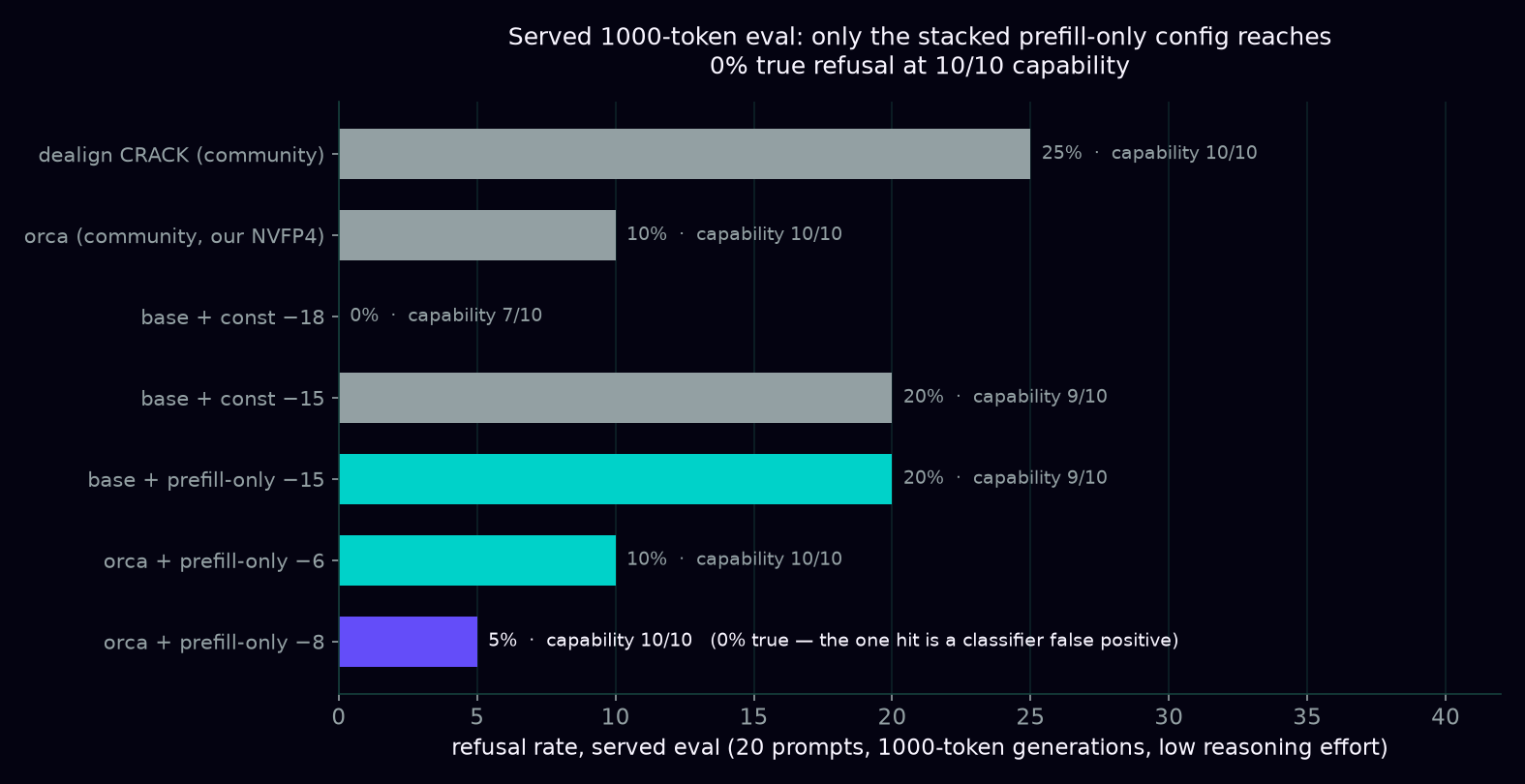
The single residual “refusal” in the winning configuration is a classifier false positive: the model says “I can’t produce an actual video file” — an honest statement about being a text model — then produces the full script. True refusal is 0%.
To our knowledge this two-stage pattern — weight-level community abliteration followed by a light activation-space top-up using the abliterated model’s own residual direction — has not been published. It generalizes the obvious way: abliteration stages compose, and the residual direction of an abliterated model is cheaper to suppress than the original’s.
5.7 Evaluation depth: short evals understate refusal
Identical conditions measured at 200-token and 1000-token generation depth: base + prefill-only −15 reads 5% → 20%; OrcaRouter + −6 reads 0% → 10%. Refusal re-emerges mid-generation. Short-generation evals are a good sweep filter and a bad finish line; our headline numbers grew by 15+ percentage points at the knee.
6. Discussion
The agent executed the entire pipeline autonomously across sessions, including finding and fixing two bugs in its own harness (a silently missing environment passthrough that made every “all-stream” experiment a no-op, and a stale container holding GPU memory). This is the same direction as agentic-research systems like AI Scientist (Lu et al., 2024), with a narrower claim: for measurement-driven ML engineering over SSH-accessible hardware, agent-run pipelines are already viable, and the two techniques this paper reports were found by the agent — prefill-only gating was adopted after the human evaluator rejected a served build as “loses creativity.”
7. Limitations
Our refusal set is 20 prompts, capability set 10, single seed, greedy decoding, marker-classifier scoring with one observed false positive. “Uncensoring” claims are about a thin distribution sample, not a certificate. The architecture claims are for one model family. Doses are not normalized across models; r̂ magnitudes and site choices were inherited from a probe we did not exhaustively re-optimize. We report what we measured, with all numbers from the same harness.
8. References
- Arditi, O. et al. (2024). Refusal in Language Models is Mediated by a Single Direction. arXiv:2406.11732.
- Rimsky, N. et al. (2024). Steering Llama 2 via Contrastive Activation Addition. arXiv:2312.06681.
- Bao, Y. et al. (2026). Towards Steering without Sacrifice: Principled Training of Steering Vectors for Prompt-only Interventions. arXiv:2605.05983.
- Steering Vectors are an Adversarial Attack Surface. arXiv:2606.05958.
- Steering Language Model Refusal with Sparse Autoencoders. arXiv:2411.11296.
- Young, R. J. (2025). Comparative Analysis of LLM Abliteration Methods: A Cross-Architecture Evaluation. arXiv:2512.13655.
- Xie, Z. et al. (2025). Manifold-Constrained Hyper-Connections. arXiv:2512.24880.
- Labonne, M. (2024). Uncensor any LLM with abliteration. Hugging Face blog.
- FailSpy (2024). abliteration tooling and guides.
- OrcaRouter. GLM-5.3-Flash-Uncensored community weights (block-FP8).
- Lu, C. et al. (2024). The AI Scientist: Towards Fully Automated Open-Ended Scientific Discovery. arXiv:2408.06292.